



|
The Department of Marine & Fisheries was created in 1867 in response to the increased fishing activities off the Canadian shores by foreign powers (primarily the US).
It started on the East Coast (United Province of Canada, Nova Scotia & New Brunswick). The year of 1871 saw the Department starting work in British Columbia.
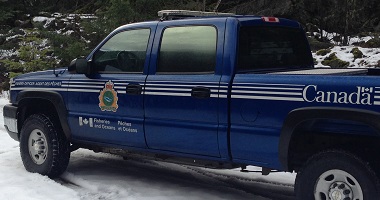
The Heraldic Crest

Originally, a codfish against a net on a blue-green background, bordered by 10 maple leaves and surmounted the Royal Crown. It is now a silver salmon, displayed on a fish net of gold mesh over a sea green background. The net is framed by a circle of gold rope which is flanked by four gold maple leaves on either side representing the Department’s eight management regions (1981).
Underlying this a gold-edged green banner with the word Canada emblazoned on it in gold. The entire design is surmounted by the Royal Crown.
Organization of Fisheries Service in British Columbia
The 1876 Act extended to British Columbia, Prince Edward Island & Manitoba. The Acts principle clauses included:
Fishery Officers having magisterial powers
Minister issuing leases and licences
Salmon fishery coming under regulation
Sale of fish in closed time prohibited
Allow building of fish-ways
Navigation or fish passage
Throwing of fish offal, dead or decaying fish, deleterious substances and sawdust into fish bearing waters prohibited
Setting aside waters for artificial breeding purposes
Illegal gear seized
Fishery Officers may convict on view, grant search warrants, pass over lands, settle disputes as to the limits of fishing stations
Power to make regulations (Gov. in Council)
Named Mr. Alex C. Anderson of Victoria as Inspector of Fisheries for Fisheries in British Columbia
1872 British Columbia's first officially reported fisheries are probably the richest in the world. Two large fishing establishments – one for salmon & other whaling in the Gulf of Georgia
1875 discussion about the destruction of spawning beds by gold miners
1878 Indian rights questioned – recommendation that Indians in British Columbia be formally exempted from general fishery law
1885 Fishing Licences initiated in British Columbia as a result of the demise of the Columbia & Sacramento Rivers
1887 Vessel Sir James Douglas patrols British Columbia as a lighthouse and buoy tender
1890 Salmon fishery declines
1894 Fisheries Protection & Marine gets recognised & authorized uniform
1930 The Province is divided into three districts:
New Westminster (all of the Fraser River)
Prince Rupert (all of the North Coast)
Nanaimo (all of the South Coast)
1936 all hatcheries closed. Air patrols cease by departmental aircraft (started in 1927)
1944 Hells Gate fish ways recommended to be built
1952 radios put in Regional Headquarters patrol vessels to improve communications
1965-66 Divided Region into Ten Districts
1968 Whaling & Reduction Herring Fishery closes
1971 Area Manager concept instituted in Region – the first time in history that Fishery Officers are reporting to non-enforcement management
1972 Roe Herring fishery starts
1976 Salmon Enhancement Program starts taking over from Research & Development Branch
1993 Department restructures – Fishery Officers’ duties in Fisheries and Habitat Management are much reduced. Officers become enforcement specialists
1995 Area Manager concept amended to a liaison role
1998 Area Management concept reinstated in region
Lower Fraser
1876 three salmon firms in British Columbia, two in New Westminster
1978 Capt. George Pittendreigh first Fishery Officer of the lower Fraser River & neighbourhood
1890 first steam launch patrolled lower Fraser (row boat before)
1884 six canneries build, first fish hatchery built on Fraser River
1896 patrol boat “Claymore” year round on Fraser River. “Quadra” covers the British Columbia coast
1915 Assistant Supervisor (C&P) created
1975 Fishery Officers on lower Fraser are armed
1977 All Fishery Officers in the Region are armed
Salmon Management “BC 16”
1868-1930 No attempt to determine escapement numbers
1930-1934 Original report had categories of light, medium and heavy · 1934 added letters: A =1-50 N = +100,000
1946-1950 added reporting physical & biological information
1967 duration of run changed from start, peak and end to: arrival in stream & duration of spawning S, P and End
1986 BC 16’s totally reworked to improve the collecting & recording of salmon data
1988 computerized data on spawning systems Habitat/Hatcheries
1873 first regulation to regulate “accumulation of sawdust in rivers” in North West Territories (Saskatchewan)
1875 Discussion of destruction of spawning beds by gold miners
1884 first hatchery built on Fraser – T. Mowat in charge
1917 nine hatcheries in British Columbia
1936 all hatcheries in Region closed
1944 Hells Gate fish ways are recommended to be built
1976 Salmon Enhancement Program formally commences rebuilding of hatcheries
A Story of the Fraser River’s Great Sockeye Runs and Their Loss
By David Salmond Mitchell (Manuscript 1925)
The following is an excerpt from the above title.
David Mitchell was employed by the Department of Marine and Fisheries and first began studying a good many big fourth year sockeye runs starting in 1889 when he conducted fisheries surveys on the runs in the lower Fraser River. In 1893 he was surveying on the Lower Fraser, from Pitt River to Hope, moving from there to the Salmon River and Shuswap Lakes. In 1901, 1905, 1909 and 1913 he was working at Granite Creek Hatchery on the Shuswap Lakes.
Hell’s Gate Blockage
When we learned that another railway was to parallel the CPR from Kamloops to the Coast, our thought at once turned on the sockeye runs. Would they be dumping great quantities of sand along the edge while the salmon were ascending, filling the gills of many with sharp grit and blasting over bluffs?
We were soon reassured on the last by learning from a newspaper that the Department of Indian Affairs had engineers on the ground with the Indians, surveying and mapping out these places where no rock must be thrown in the river. This was done to protect the ancient fishing places of the Indians.
Unfortunately no claim had been put forward by the Indians for Hell’s Gate, a place where the salmon always had difficulty, about 185 miles down the river from the hatchery. The Indian family that had used Hell’s Gate had probably died out.
It was an ideal place from a contractor’s point of view for the disposal of the rock taken out in boring Hell’s Gate Tunnel. He had no doubt taken that into consideration when figuring on the job.
It was the rock out of the tunnel that blotted out the great runs of sockeye salmon to the Fraser River, after the volume of passing water had become reduced with the advance of the season.
The great floods of water coming from the glaciers and snowfields of the Interior, raise the Shushwap Lakes, (106 miles long, by 2¼ wide), from 11 to 14 feet above their low water mark. The highest water is in June.
When the sockeye reach the Shuswap, the lake level is falling and the amount of water passing through the Fraser Canyon is gradually becoming reduced.
The sockeye with the big flow of water were getting past hell’s Gate but with the reducing flow the passage was becoming increasingly difficult. Before the run was more than started it was shut off.
The females were the first to fail in getting through.
All barrels in the Interior, had been scrubbed and aired, and all the salt had been bought up in expectation of the big run.
New comers were told by neighbours of the wonderful sight, and advised to send for barrels. They would be able to walk across the rivers on the backs of fish.
When the fish didn’t come there were complications. Reputations for veracity became badly distorted, protests, redeclarations, and calling for witnesses, only added to the contempt.
They were all blankety, blanked economizers of the truth. It was said “the Hatchery people, or the Indians must surely have the river blocked”, and a party was sent down the Salmon River, to tear out any barricades and let the fish up. They returned with the news that they could find neither barricades nor fish.
After a while news came of the blockades at Hell’s Gate Tunnel and other places, and after the people had for some time been lamenting about the great loss, and saying that the CNR should be made to pay for it, news came that a slide had now been brought down.
There were very few females among the sockeye that got past Hell’s Gate before the water fell.
The Salmon River, a run which I described in the foregoing, was a total blank in 1913. Not a sockeye, coho, or pink salmon spawned in it.
It was estimated that about one thousand sockeye entered, but these were all speared by settlers below a sawmill dam.
The following paragraphs have been added by editor, Stefan Beckmann.
On February 23, 1914, a huge rock cliff above a newly blasted (CNR) railway tunnel collapsed into the river at Hell’s Gate. More than 100,000 cu. yards of rocks as big as houses entered the river. The slide material narrowed the canyon at that point from about 300 feet to 75 feet and formed a cascade of water dropping more than 20 feet over a distance of less than 75 feet. With such a catastrophe, it was soon clear that the salmon runs expected to arrive the following summer would not make it upriver.
Rock blasting and temporary fishways were found to be only marginally effective. Upstream migration remained severely restricted.
It was not until 1946 that the Hell’s Gate Fishways were completed. Since then, with the assistance of spawning channels, the Fraser River runs have recovered to over 80% of their former abundance
HMCS Galiano
The Naval vessel "Galiano" sank in stormy seas in October 31st, 1918. The Galiano had been conducting fishery and Naval patrols from 1913 until she went down in October of 1918. One of her crew, Mr.James Vinicombe may have been one of the earliest fishery officers to lose his life on the Pacific Ocean, in the line of duty.
Feared Steamer "Galiano" Has Gone Down
"Victoria, Oct. 30 -- Naval authorities today received word regarding the Dominion government steamer, Galiano, which gives rise to apprehension for her safety. The Galiano is in the lighthouse service enroute from Triangle Island to Ikeda, Queen Charlotte Islands. Last night a message calling for help was picked up from Galiano by government wireless. The message said that the vessel was taking water into her hold very rapidly. No further word has been received from her. The Galiano had a crew of thirty men."
October 31, 1918
read more>
This site is for the use of society members and the general public.
Any information contained herein is for information only. For more information contact the Webmaster, all materials © 2009 |